

How EOS Empowers Growth and Accountability
Building on the Master Martini ANZ story from the previous LinkedIn article, where EOS drove clarity amid rapid expansion; this article follow-up explores EOS’s impact across industries.
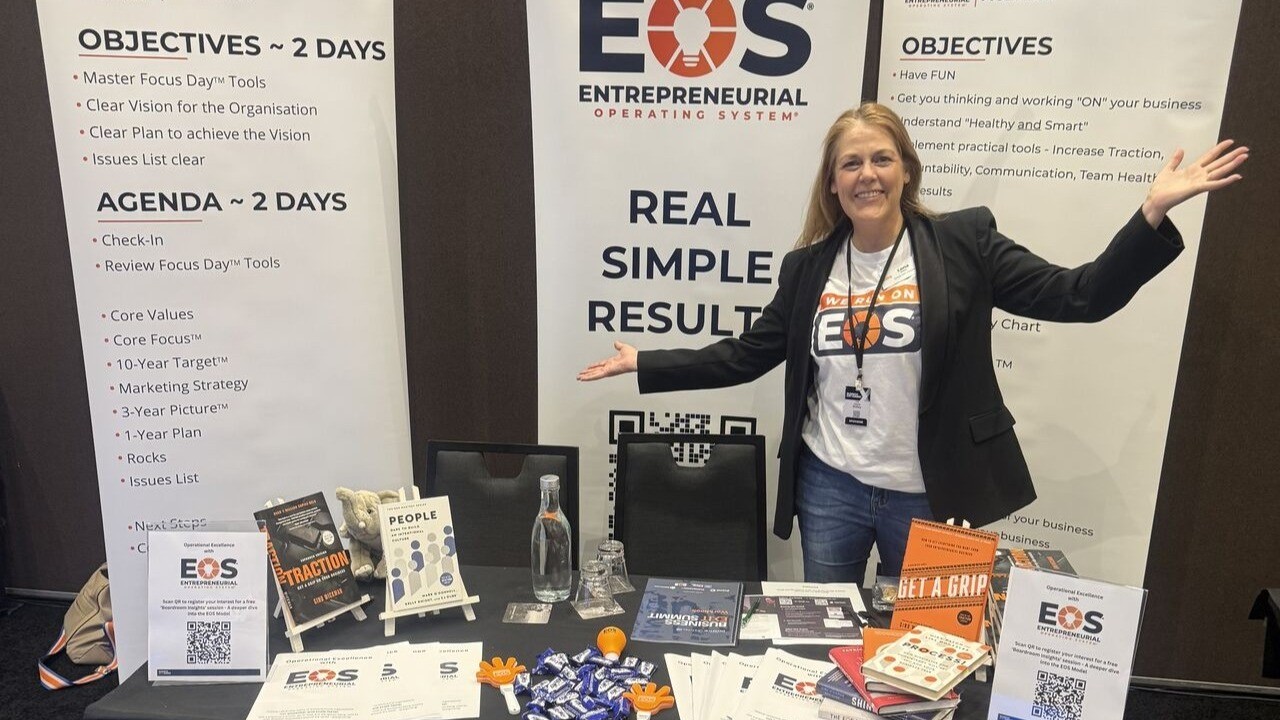
Insights come from Lena Ridley, a Professional EOS Implementer. With over 25 years in business, including starting four ventures and embedding EOS in her own firm, Lena guides leaders in Australia, Sri Lanka, and Singapore from Sydney.
EOS, proven in over 275,000 companies worldwide, integrates six core components: Vision, People, Data, Process, Issues, and Traction; to align teams and drive results in sectors from manufacturing to professional services.
Insights from Lena Ridley: Q&A on EOS
1. How would you describe EOS to a business leader who’s never heard of it before?
The Entrepreneurial Operating System® (EOS) is a powerful management operating framework that takes a holistic, self-sustaining approach to building a great company. It helps a business owner get the most out of their business. EOS Implementers have delivered over 205,000 full-day sessions globally for more than 30,000 companies. As a result, companies:
- Crystallise their vision, getting everyone on the same page and rowing in the same direction.
- Gain tremendous Traction® by building discipline and accountability into the organisation.
- Create a healthy, functional, and cohesive leadership team and company.
It is a way of running the business week in, week out.
2. What are the most common challenges you see companies face before implementing EOS?
Across industries, I see the same patterns:
- The vision lives in the founder’s head. The rest of the team is guessing or working from their own version of the truth. Alignment is tenuous at best.
- Everyone is busy, but not always on the right things. Lots of activity, not enough traction.
- Roles are fuzzy. People wear too many hats, or no one is truly accountable for key outcomes.
- Firefighting culture. The team spends more time reacting to issues than preventing them.
- Meetings that go nowhere. They are long, unfocused, and do not end with clear decisions or owners.
EOS does not magically remove all problems, but it gives you a structure so you can see them clearly and solve them permanently instead of living with them.
3. How does EOS specifically help logistics, or supply chain businesses or businesses in general?
Logistics is complex, time-sensitive, and unforgiving. Mistakes show up quickly in service levels and margin.
EOS helps logistics and supply chain businesses in a few very practical ways:
- Right people, right seats: You get absolute clarity on who owns network design, who owns fleet utilisation, who owns warehouse productivity, who owns customer experience – and what success looks like in each seat.
- Real numbers every week: The Scorecard makes key lead and lag indicators visible every single week so you can act early, not three months later.
- Clean processes: The Process component forces you to document your “Proven Process” of routing, scheduling, pick/pack, POD, customer communication, etc., so quality does not depend on one or two heroes and gives your customers a clear expectation of their experience.
- Issues get solved, not recycled: In logistics, the same issues can pop up in different guises. EOS gives you a discipline (IDS® – Identify, Discuss, Solve) to fix root causes and protect your margins.
For any growing company, but especially in logistics, EOS builds calm in the chaos so you can scale without the wheels falling off.
4. What is the role of an EOS Implementer beyond teaching the model?
An EOS Implementer is not a trainer; they are a teacher, a facilitator, and a coach … and come with decades of their own business experiences.
Beyond teaching the tools, my role is to:
- Create a safe but challenging environment where the leadership team can have the real conversations they may have been avoiding.
- Draw the vision out of the team – not impose my own – and help them align around one clear plan.
- Coach on behaviour and discipline: It is one thing to fill out a Scorecard; it is another to hold each other accountable to it every single week.
- Keep everyone honest over time: I am there in the room every 90 days to test: are you really using the tools, or have you slipped back into old habits?
In short, I do not “install EOS and leave.” I help build internal capability so the business and leadership team master the tools and can ultimately run EOS confidently without me.
5. Can you share a success story from an Australian business adopting EOS? Example with Master Martini
With Master Martini ANZ, the story is a great example of what happens when a leadership team commits to an operating system.
Before EOS, they were like so many growing businesses:
- Expanding rapidly,
- Lots of good people,
- But decisions and priorities competing for attention.
Through EOS, they:
- Got very clear on their 10-Year Target, 3-Year Picture™, and 1-Year Plan, so everyone understood what “winning” looked like.
- Built a Scorecard around the metrics that really drive their customer experience and outcomes, as well as sales revenue and financials.
- Tightened up accountability so every function knew exactly what it owned.
The result is a laser focus on the priorities with the most impact, a culture clearly defined by the values that make the business and its people unique, and an operating rhythm where issues are surfaced early and solved together – which is exactly what you need when sales and logistics are at the heart of your growth stor
6. What does a typical EOS journey look like for a leadership team?
A typical journey runs over about 24 months and looks like this:
- 90-Minute Meeting: I meet with the leadership team to walk through the EOS model, answer questions, and decide together if there is a fit.
- Focus Day™: We start by building clarity around roles and accountability, setting Rocks as immediate priorities, and a simple Scorecard so you start getting control quickly.
- Vision Building™ Days (x2): We dig into your vision – who you are, where you are going, and how you will compete – and turn it into a simple, shared plan on one page (the Vision/Traction Organizer®).
- Quarterly Pulses: Every 90 days, we step out of the whirlwind to:
- Review the last quarter
- Reset priorities (“Rocks”)
- Tackle the big issues in the way
- Annuals: Once a year, we take two days to work on strategy, team health, and longer-term direction.
Over time, the leadership team becomes fluent in EOS, and the tools cascade through the rest of the organisation.
7. How does EOS support company culture and leadership alignment?
Culture is often talked about in values on the wall. EOS makes it visible in behaviour.
- We start by identifying your true core values – the ones you actually hire, fire, review, reward, and recognise around.
- Then we use tools like the People Analyzer to check if people really live those values and are in the right seats.
- The L10 Meeting™ structure builds a culture of open, honest, healthy debate every week, which is where real alignment happens.
The net effect is a culture where:
- Leaders are rowing in the same direction,
- People know what is expected,
- And conversations about performance and fit are normal, not taboo.
8. What advice would you give to businesses hesitant about adopting an operating system?
I would say three things:
- You already have an operating system – it might just be accidental. If you do not choose one, you end up with a mix of habits, personalities, and “this is how we’ve always done it.” That is still a system – just not a deliberate one.
- Start small, but start. You do not have to “marry EOS” on day one. Come to a 90-Minute Meeting, see if the tools resonate, and test them in your leadership team.
- Look at the cost of doing nothing. The cost of misalignment shows up in overtime, rework, missed deliveries, and lost customers. A simple, proven operating system is often cheaper than staying stuck where you are.
9. How does EOS keep teams accountable while remaining flexible to change?
EOS is structured, not rigid.
Accountability comes from:
- Clear seats and scorecards – everyone knows the numbers they own.
- Weekly L10 meetings – every week, you review priorities, metrics, and issues.
- Quarterly Rocks – 90-day priorities that keep the team focused.
Flexibility comes from:
- Resetting Rocks every quarter – if the market, customer requirements, or network change, your next 90 days can change too.
- The Scorecard – if a metric stops being useful, we change it.
- The Issues list – every week you are, encouraged to raise and solve new realities, not pretend the plan was perfect.
So, EOS gives you a strong backbone but still lets you pivot when the environment demands it.
10. What trends or developments do you see for EOS adoption in Australia over the next few years?
In Australia, I see three big trends:
- More adoption across sectors. EOS is not just for tech or professional services – it works brilliantly where operations are complex, distributed, and time-critical.
- Growing demand for clarity in mid-market companies. As businesses scale through and past that 10–50-person mark, the old ways of “managing by memory and meetings” stop working. EOS is increasingly becoming the go-to operating system for businesses with 10-250 employees.
- Deeper integration with data and technology. More EOS-run businesses are tying their Scorecards into real-time dashboards and running through purpose-built EOS software, not spreadsheets and Word documents. AI is helping leadership teams focus on the value of humanistic leadership, using structure, data, and tech to free up more time to excel with relationships.
Overall, I think we will see more Australian businesses treating the way they run the business as a strategic asset – and EOS will be one of the main operating systems supporting that shift.
As a gift to readers, please contact me to receive Traction: Get a Grip on Your Business and read more about the EOS model for yourself.
Reach out to Lena Ridley for a chat at (+61) 0437 690 298 Or [email protected] ,
and you can find out more from eosworldwide.com
Explore more practical content on our blog at engagefinancial.com.au/blog


